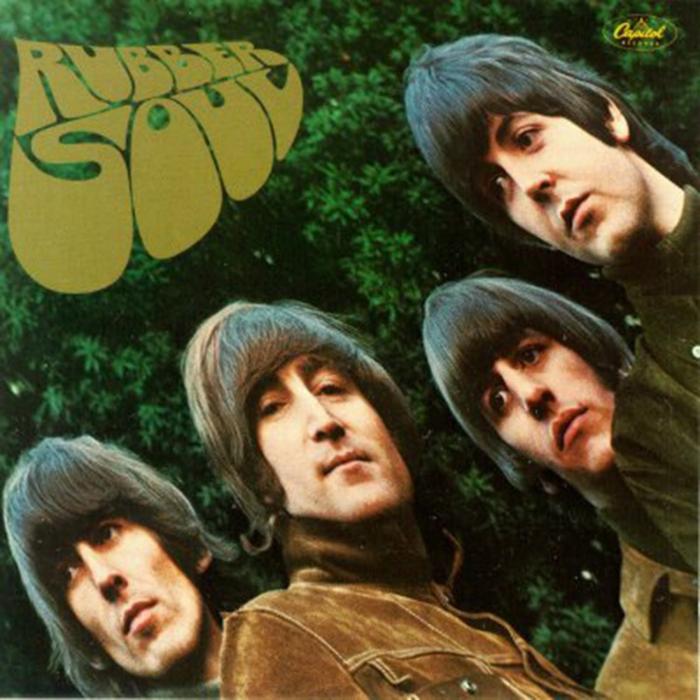
With Rubber Soul, the Beatles proved their durability as a band capable of growth and change, thereby cementing their position as one of the most(if not the most) consequential acts of the remaining Sixties. It was a significant achievement because they’d burst upon the scene and rode the waves for a couple of years. However, such exuberance(or mania) could not be sustained. Sprinters don’t run the mile, and even the biggest explosions fade away. Not that their first impression was limited to teenybopper pandemonium, though it seemed so at the time when many adults(and Rock n Roll purists) dismissed the whole thing as more fad than fab. Beatlemania was so over-the-top and unprecedented — not even the hysterics surrounding Elvis Presley came close — , so delirious and bordering on deranged, that many just assumed that sober minds would ultimately prevail and the Beatles would be seen for what they truly are, a passing fashion(or flu season).
On some level, Beatles must have sensed it as well. Ringo once said his long-term plan was to cash in on what he expected to be short-lived stardom and open up a string of hair salons. And even though John, Paul, and George were elated by their sudden rise to fame, they couldn’t help but notice the fans came to the concerts not so much to hear the music but themselves scream, leading Beatles to play in a ever more perfunctory manner on the assumption that no one, the band included, could hear the music amidst the cicada-like shrieking of young girls(and some boys) — later, when the Beatles played to a somewhat subdued audience in Japan and actually heard themselves play, they realized how much their performance quality had slipped. Still, despite the noise of the crowd, Beatlemania happened in the first place because Lennon and McCartney invented a new kind of sound that refined the Rock n Roll into something faster yet mellower. The result was louder but more pleasant, more about revelry than rebellion. It rolled like thunder and coddled like a lullaby. They’d arrived at the Coca-Cola of Pop. Sharp and soothing.
But the sudden success posed a problem. Wouldn’t such a rave act exhaust the fuel sooner than later, or to put it in a more vulgar way, didn’t it blow the wad too early? It was as if they began atop the climax, the highest peak of any rollercoaster, but what would happen at the bottom rail? Would they just be replaced by new idols as the detractors predicted or would they somehow defy the odds and keep the momentum going? As the title of one of their albums implied, the secret to survival was to offer ‘something new’ at every turn, in a way a pop cultural reflection of Western Progress’s precept of ‘evolve or go extinct’, which non-Western civilizations found out the hard way in confrontation with the ever advancing West in the fields of science, technology, and organization.
Irrelevance and extinction would indeed be the fate of most of the British Invasion acts, even some first-rate ones like, for example, the Dave Clark Five. DC5 were almost as fabulous as the Beatles in their initial outing. If anything, they could be even more rambunctious, and their best songs had a similar mix of melody and madness. The difference was DC5 had nothing to go on but the original formula and faded once the fashions and attitudes changed. When the teenyboppers of 1963/1964 later turned onto Rock as personal expression or even art, Dave Clark Five was just a blur in the rearview mirror, a reminder of their younger days. (Besides, the new batch of teenyboppers had the Monkees and the like.) As remarkable as the Beatles were from 1962(when they hit upon the magic formula with “Please Please Me”) to 1964, their later fate might have been like the Herman’s Hermits’ but for the fact that they demonstrated, decisively and resolutely, with Rubber Soul that they were capable of change and growth, and determined to lead.
From late 1963 all throughout 1964, Beatles were such a dominant force that the future direction of pop music was up in the air. The attention was focused on the Now, as Beatlemania seemed the biggest phenom in pop culture history. Just about the only competition, in quality and inspiration, comprised the Beach Boys and Motown. The Rolling Stones hadn’t yet made their mark. Bob Dylan was still a folkie, and the notion of Folk Rock would have been ludicrous, as Dylan discovered the hard way soon enough when the Folkies clung to the Culture War formulation of Folk vs Rock. And many of the great acts of the late 60s had yet to emerge or take shape.
It was in 1965, possibly the greatest year in Rock/Pop, that music culture finally began to materialize into something of significance and meaning to the Boomers, as it was transformed from entertainment to the artform of the generation. The Beatles of 62-64, unique and fresh as they were, still embodied the iron rule of popular music, the primacy of pleasing the fans. Their first #1 hit “Please Please Me” said as much. It’s about pleasing the other to be pleased in turn. Beatle-Mania was a back-and-forth dynamic between the band so eager to please the crowd(to orgasmic raptures) and the crowd so happy to please the Beatles in turn. For all their talent and inspiration, Lennon and McCartney knew the Mania was the hungry dragon that had to constantly fed. And in concerts, the roar of mania drowned out the music. So, all said and done, the mop-top version of the Beatles constituted feeders of popular appetites, the biggest fast-food franchise in pop music, rather than artists in the truest sense. Initially, they strode atop the mania, but it soon engulfed them, sometimes in terrifying ways, like in Philippines when the hysteria turned from love to hate. Despite their frozen smiles on the tour, they came to resent the mania(and its manipulators) and, incredibly for a band that came to fame with frenzied fans, quit the concert circuit altogether in 1966. Beatles may have been bigger than Jesus, but the Mania became bigger than the Beatles, and it’s no wonder Lennon jumped at the opportunity to withdraw into his acid trips. And McCartney’s perfectionist vanity grew tired of the amateurism on concerts and favored the studio where his skills could be honed as instrumentalist and arranger alongside George Martin.
Anyway, 1965 was when, in the cooling climate of the post-Beatles-Big-Bang, a new star cluster of music began to coalesce, generating a new kind of heat, one that the Beatles couldn’t help but notice, if only to remain in the game. In that year, Stones staked their claim to the throne with “Satisfaction” and “Get Off Of My Cloud”, setting off the great Rock rivalry with the Beatles. Bob Dylan ‘went electric’ and dropped “Like a Rolling Stone” like a bomb, Byrds perfected Folk Rock with their rendition of “Mr. Tambourine Man”, The Who radicalized Rock with “My Generation”, Paul Simon came into his own with “Sounds of Silence”, Brian Wilson unveiled a new sophistication with “California Girls”, and Motown got even better. Henceforth, one had a pretty good sense of where the music was headed for the rest of the decade. It was going to be a fierce(but also friendly)contest of wills, egos, and personalities. By 1965, the promising acts, formed or on the verge of forming, had a strong sense of what they were and were capable of. But not in 1964 when Pop Music was still reverberating around Beatlemania, the only question being, when will it end and then what?
Even in 1964, however, John Lennon and Paul McCartney, sensing their immense potential, were eager to move in new directions. (As different as the duo were from Bob Dylan, what they all had in common was the conviction of having ‘it’, something that set them apart from the others, a sense of destiny.) But how would ‘it’ be manifest? Among the early signs was McCartney’s pensive “Things We Said Today”. Now, let it be said that the Beatles weren’t about meaning, and nothing they did, even at their most artful, had much in the way of depth, true of 99% of Rock music. The difference was in the thunderous power on the one hand(owing to blues roots & electricity) and the poetry of emotions on the other(especially by way of folk idioms and pop techniques). Even Dylan’s sophisticated use of lyrics was more to paint moods and impressions than to convey meaning, something that went over the heads of folkie-centric fans who demanded sermons and instructions.
As the decade progressed, musicians found ways to rock harder, culminating in Jimi Hendrix and Led Zeppelin, before Heavy Metal turned it into a cartoon. But, there was also a motion toward interiority, songs adrift in private dreams than pandering to familiar boy-meets-girl sentiments. Generic pop emotions of love and heartache gave way to something akin to monologues of unresolved feelings and unrequited dreams. Most songs either addressed the object of one’s love interest or the third person, the collective mind of the listeners, but the new sensibility had the singer musing to himself, often forlorn and oblivious to the world. Consider “Sad Memory” by Buffalo Springfield or “Everybody’s Been Burned” by the Byrds. Or “Fotheringay” by Fairport Convention and “Ruby Tuesday” by Rolling Stone. Or “Fool on the Hill” by the Beatles.
The art of ballad is about the fine-tuning of moods, like the craft of turning a diamond in the rough into a brilliant gem. With songs like “Things We Said Today”(and partly “All My Loving” prior), McCartney strove for something subtler though within the perimeters of a pop song. (When McCartney later actually tried to SAY something in “She’s Leaving Home”, he fell flat on his face. All he needed was the ingenuity of peeling away another layer of emotions to reveal something fine and as yet unseen.) Even the loud Beatles songs began to develop in structure, like “When I Get Home” and “Anytime At All”. Fairly or not, Lennon got the credit for initiating the change in direction, in part under the influence of Bob Dylan. “You’ve Got to Hide Your Love Away” and especially “I’m a Loser”(on UK release Beatles for Sale and US release Beatles 65) have been lauded as Lennon’s early attempts to evolve as a song-writer. Dylan’s introduction of marijuana surely contributed to the altered approach to music: Less twist-and-shout and more think-and-doubt.
With the release of Beatles for Sale(and its US variation Beatles 65), the high-strung energy was still there but under a cloud. It sounded more desperate than confident. The early spontaneity was missing, and the forays in new directions were hesitant and halfcocked(more trepidation than experimentation), though “I Feel Fine” was a real breakthrough. The Beatles were offering more of what had made them popular in the first place but stuffed with half-hearted imperative for change. So, “No Reply” and “I’ll Be Back” are denser in their emotions, bitter or yearning. As such, the Beatles at this moment sounded like a Janus-like hybrid band facing backward and forward.
Same was true of their next album Help!, though the Beatles clearly jumped the hurdle with an undeniable knack for reconstruing the basic elements of their sound into amazing new melodies. In one respect, Help! is their best album, that is if judged by the number of great songs. Many great albums hardly contain a great song, and their high estimation rests on a string of very good songs. Or they have one or two great songs and some very good ones. Incredibly, Help! has three great instant classics: The title song, Yesterday(which will last forever), and Ticket to Ride, maybe their greatest rocker. Arguably, the Beatles that recorded Help! embodied the perfect balance between the earlier spontaneity and the new mastery, and the three aforementioned songs are amazing in every way. Also, the other songs on Help! range from good to very good, especially “Another Girl”, “You’re Going to Lose that Girl”, and “Night Before”. I also like George Harrison’s “I Need You”. (Of course, we mean the British version as the U.S. version lacks “Yesterday” and few other songs, replaced with a bunch of instrumentals from the movie.)
On the other hand, Help! sounds like a random collection of songs rather than an album in the organic sense, as the format came to be valued in Rock Culture. Rock Album is akin to a photo album. The songs are best threaded together by a theme, attitude, or vision(or ‘concept’ in more ambitious projects). Photo albums tend to be categorized similarly: The wedding album, school trip album, family album, friend album, nature hike album, and etc. Help!, outstanding as it is, comes across as a jumble of songs packaged for a movie soundtrack. As such, it lacked the resonance that their next album Rubber Soul delivered in spades. (One thing for sure, Sixties popular music would have been profoundly different had the Beatles never existed, but it would progressed more or less the same had the Beatles perished in a plane crash after Rubber Soul.)
With Rubber Soul, it was as if the Beatles wanted to prove they had something more than youthful inspiration, a genuine musical talent independent of stardom, i.e. they were more than a cultural phenomenon whose success relied solely on fan mania. Thus, it is sort of like the Beatles Unplugged, as if to say, “We’re in a silent room and the electricity is off. Just listen to what we can do with the basic elements of music.” Not something to dance to or scream about but to sit down and listen to. While electric guitar is used at times, most of the songs are acoustic(and even the electric ones could do nearly as well without). As a chamber piece, it was an album to ponder than pound in the ears.
There was bound to be some confusion because of the album’s title and the two versions of some significant difference. The title implies the Beatles as the players of white soul, a plastic version of the real thing. But, while the Beatles drew inspiration from rhythm-and-blues and Rock-n-Roll(and black Girl Groups and Motown), most of the songs on Rubber Soul belong in another category. Only “Drive My Car”(missing on the U.S. version) and “The Word” have anything soulful about them, and the rest are ballads or standard pop melodies.
The bigger issue is the question as to which version is more authoritative(and better), the British version or the U.S. version? Quantitatively, the British version has more songs, especially “Drive My Car”(never my favorite but a very good song) and “Nowhere Man” that rings with Lennon’s customary brilliance. It also has George Harrison’s “If I Needed Someone”, a pretty good song. Those songs(and the lackluster “What Goes On”) are missing on the U.S. version that instead has “I’ve Just Seen a Face” and “It’s Only Love”, originally on the British version of Help! Most people would agree “Drive My Car” and “Nowhere Man” are superior to “I’ve Just Seen a Face” and “It’s Only Love”, and it would have hurt the U.S. version none to include “If I Needed Someone”.
Yet, from the consideration of the Rock Album as an organic unity, the U.S. version works better. “I’ve Just Seen a Face” and “It’s Only Love” are perfect fits with the other songs on the U.S. version of Rubber Soul, indeed far more so than on the album Help! It’s as if they found their real home on the subsequent American album. In contrast, “Drive My Car” sticks out like a sore thumb and would have done better on an earlier album. “Nowhere Man” would have been better suited for the next album Revolver with songs like “Tax Man” and “Yellow Submarine”.
Now, the U.S. version of Rubber Soul has only one great song(possibly two, with “In My Life”). It is “Norwegian Wood” where John Lennon, calm and reflective, recalls a chance affair that lingered in memory for reasons he can’t quite fathom. Perhaps, it was his answer to McCartney’s “Yesterday”. Or maybe he quit being consciously Dylanesque and just let go, waiting for an inner voice that, under the right mood and turn of mind, would emerge of its own accord. Its narrative seems to intimate the creative process of the song itself, i.e. he stumbled upon unfamiliar feelings, which became the basis of the song that emerged from a mysterious place. A song he couldn’t have found by looking but one that had to find its way to him. In the tale, he entered a woman’s adobe, they did whatever they were supposed to do, but in the morning, she had to ‘work’, and he to vacate the room and sleep in the bathtub(while the bedroom was taken up with another man perhaps, which makes us wonder what her line of ‘work’ is). He woke up later to find her gone, and he found himself alone and placed a log in the fireplace. Who is this woman, and why does she affect him so? And, is the protagonist meant to be John Lennon himself or a fictional character in a mini-story? If meant to be Lennon himself, perhaps what he noticed most was her independence, a life according to her own rules(in proto-Swinging-London style). John Lennon was a Beatle at whose feet so many girls would have prostrated themselves. And his wife Cynthia was ever so tame and loyal. But, the song describes a woman who was indifferent to his fame and fortune. He was just another acquaintance, lover, or client. And she’s such a carefree busybody that she exited the place with him still sleeping in the bath. It’s not the woman per se but something about her that his mind can’t quite let grasp. Perhaps, an easygoing egotism to match his. He could have any bird in the world, but this one bird had flown. Thus, it is a rather odd love song if it indeed one. Whereas “Yesterday” is clearly about a man thinking of a woman, “Norwegian Wood” is about feelings evoked by a woman despite the lack of any real bond between them. About what might have been(and never will be) than what once was. It’s not about the feelings for a woman but the responses stirred by her qualities, both easy and elusive, indeed elusive precisely because so accessible, to any man of her choosing. The man in the song isn’t in love with the woman and could just walk away. And she does her own thing and isn’t bound to him or anyone. Is she a free spirit or a self-centered bitch? Either way, she has her own wings, coming and going as she pleases, rather like him. Could they be kindred spirits… except, if the man is really meant to be John himself, he is bound to Cynthia Lennon, a woman he never cared for and married only out of a sense of duty(as she became pregnant with his child). Perhaps, the song offers a clue as to why Lennon was so taken with Yoko Ono later. She had a mind and will all her own.
In “Norwegian Wood”, gone is the self-pitying strain of “I’m a Loser” and the ingratiating vibes of “You’ve Got to Hide Your Away”(as if to prove he can do something more than boy-love-girl songs). It’s as if Lennon finally tapped into the inner poet as guide to his next phase of creativity. It is perhaps Lennon’s finest ballad, equaled only by “Watching the Wheels” on his last album Double Fantasy. It has the delicacy of “Yesterday” but with a shade of perversity. McCartney’s song is about the pain of something had but lost, whereas Lennon’s song is about the haze of something not worth having but beguiling just the same; you can have her body but not her spirit. It is one of Lennon’s handful of sublime achievements.
Among Lennon’s other songs on the album, “In My Life” is exceptionally good, and its nostalgia would later come to bloom with “Strawberry Fields Forever”. As for “The Word”, “It’s Only Love”, “Girl”, and “Run for Your Life”, they’re all solid tunes and add to album’s consistency. George Harrison’s lone contribution on the U.S. album, “Think for Yourself”, is one of his best. Though harder-edged than the other songs, it shares their sense of interiority, i.e. the song is more like an angst-ridden monologue of feelings tied up in knots. While none of McCartney’s songs counts as great, they are first-rate across the board, sustaining a high level of creativity and craftsmanship. Especially notable are “You Won’t See Me” and “I’m Looking Through You”. (Of course, it needs to be said a lot of Beatles songs got attention, sometimes undue, simply because they were by the Fab Four. “Michelle” is good but far inferior to any number of French chansons that inspired it. And while “Girl” is nice with its Greek touch, why not go for the real Greek stuff that has more flavor?)
For the first time, the songs sound detached from and even indifferent to the phenomenon of Beatlemania, as if composed on a sabbatical, far removed from the constant buzz of fandom. And even though most songs involve romance, they’re about women than girls, about feelings borne of experience than adolescent expectation.
With Rubber Soul, the Beatles crossed the hurdle. They had within them something that would last beyond the initial spring of Beatlemania with its mobs of shrieking teenyboppers. Away from the spotlight, with minimal electric input, looking inward than outward, they proved to themselves and the world that they were here to stay, at least as long as they were willing to explore the fuller range of their talent. It was the moment the Beatles decisively diverged from the fate of the Dave Clark Five. For better or worse, it also started the process by which the Beatles would give up touring altogether the following year.
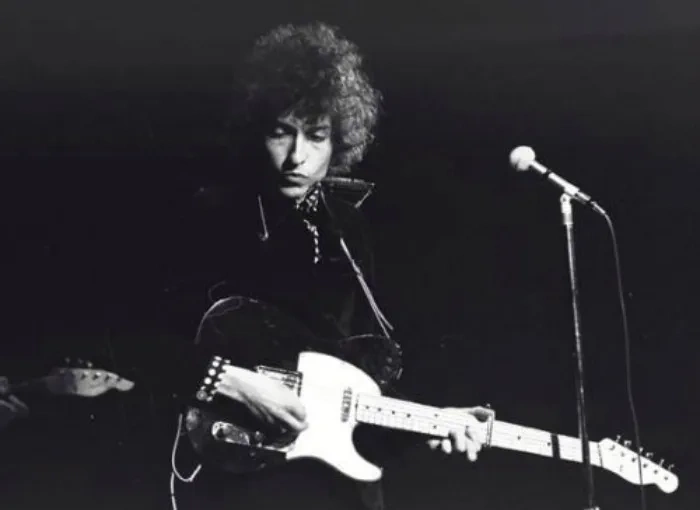
If the Beatles went ‘acoustic’ with Rubber Soul to show that they were more than a Rock n Roll act from Britain, Bob Dylan had something similar to prove, albeit in reverse order, and it would be hugely controversial, dogging him for several years. Whereas the gaggles of Beatlemanical teeny-boppers uncritically accepted the gentler, maturing Beatles(and would themselves grow into new attitudes), the folkie fans of Bob Dylan had an almost messianic attachment to him as the spokesman of his generation, the poet-prophet of the age, the chosen one who would bear the torch passed to him from Woody Guthrie and Pete Seeger.
So, when Dylan decided to ‘go electric’, it wasn’t regarded merely as a new direction but an outrage, an act of betrayal. It was like Harvey Keitel’s Judas berating Willem Dafoe’s Jesus in THE LAST TEMPTATION OF CHRIST for having reneged on his mission on Earth. Indeed, for the next two years, ex-fans would attend his concerts just to boo and jeer him and the Band(led by Robbie Robertson) — the sheer level of derangement has been downplayed over the years by leftist boomers who didn’t want to admit what a priggish and humorless bunch of ideologues they once were.
If the Beatles wanted to prove they could make music without the noise, Dylan wanted to prove he could rock with the rest, and that called for amplification, or Dylan plugged. Folkie purists denigrated Dylan for ‘selling out’ to become a pop star, but they missed the mark. While Dylan clearly craved Rock stardom, he was striving for art than pop in music. Indeed, most Dylan songs that hit the charts(usually as cover versions)were composed during his folkie period: “Blowin’ in the Wind” and “Don’t Think Twice, It’s Alright” by Peter, Paul, and Mary, “It Ain’t Me Babe” by the Turtles, “All I Really Want to Do” by Sonny & Cher, and the like. Furthermore, the Byrds, the premier interpreters of Dylan songs, mostly covered the songs from his folkie period. And even though “Mr. Tambourine Man” was released on Dylan’s partly electric album Bringing It All Back Home, Dylan’s version was acoustic and within the folkie idiom.
So, the whole Dylan-goes-electric controversy was rather misconstrued by the diehard folkie purists. It was actually less about folk purity vs pop commercialism than about folk dogma vs personal art. Apart from “Like a Rolling Stone”, hardly a song on Highway 61 Revisited had much commercial viability. Songs like “Queen Jane Approximately”, “Just like Tom Thumb’s Blues”, “Ballad of a Thin Man”, and especially “Desolation Row” were unlike anything recorded in Rock and Pop. The surreal songs on Blonde on Blonde were even less suited for Billboard charts, though “Rainy Day Woman #2” became a kind of novelty hit.
In retrospect, Rubber Soul is a remarkable album and a pivotal work for the Beatles, but it was Dylan who really turned the Rock world upside down with his monumental masterpiece(that incredibly was topped by an even greater work the following year). And of course, there was the Stones with “Satisfaction”, though it was only with Aftermath in 1966 that they finally mastered the art of the Rock Album as unified expression. Dylan went electric not to fill up concerts but to use the added charge to break through new avenues of expression. Folkie reins weren’t enough; he needed the electric whip to get his chariot going. And he went so very so far very fast, so much so that he veered from riding off the cliff and pulled back(like the game of ‘chicken’ in REBEL WITHOUT A CAUSE), withdrawing into family life and releasing the acoustic John Wesley Harding in the final days of 1967. Though acoustic, it has more in common with his two electric predecessors than with his folkie output. It too is defined by artistic aspiration, an egoism that was anathema to folkie purists despite the absence of commercialism. For many leftist folkies with the Popular Front mentality, art should be social and relevant, not dwell on personal life, let alone psychology, which was deemed self-indulgent or ‘bourgeois’.
There’s been a lot of buzz about Peter Jackson’s latest Beatles documentary GET BACK. I haven’t seen it nor am I eager to. Peter Jackson made his name with Art Horror(the vile and disgusting HEAVENLY CREATURES), Fantasy(the interminable THE LORD OF THE RINGS, the longest dungeons-and-dragons video game), and Adventure(the remake of KING KONG, fun rollercoaster ride followed by a rather innocent tale of an unlikely friendship, minus the socio-sexual innuendos of the first two versions, probably the high point of his career). Peter Jackson’s problem is excess. Like Maxwell Silver of Paul McCartney’s song, he can’t help slamming you over the head. The camera becomes a hammer, or cammer. THE LOVELY BONES, for instance, was conceptually tantalizing as a twist on murder-mystery but, overblown with outlandish effects, left no room for nuance and subtlety. Jackson belongs in the Ken-Russell-and-Terry-Gilliam School of More-Is-More. He certainly isn’t David Lynch. Some may argue THE LOVELY BONES suffered as the result of coming on the heels of THE LORD OF THE RINGS movies that gave Jackson the opportunity to indulge himself with bigger-budgets when smaller production values with a lighter touch would have been more suitable for the material. More fodder for a fatso with a big appetite isn’t always the wisest thing. But then, his first notable film HEAVENLY CREATURES had a budget of only $6 million yet it was over-the-top just the same. Maybe, physiognomy is real; Guillermo Del Toro, who resembles Jackson, is also nothing if not excessive, with the added vice of arthouse pretensions. Who would have thought someone would win the Oscar for Best Picture with a movie about a woman having sex with the creature-from-the-black-lagoon as stand against ‘racism’?
Jackson’s foray into documentary-filmmaking suggests a serious side or a striving for respectability(long after having began his career as a trashy horror movie-maker). And yet, his first documentary THEY SHALL NOT GROW OLD seemed a bit gimmicky as most of the original black-and-white images were colorized. It could be justified on grounds that Jackson was attempting to recover a sense of actuality from the archival material. The momentous World War I or the Great War may have been the first great event to have been extensively captured by the nascent means of representation that would come to dominate the century as document, propaganda, entertainment, and art. It was as if cinema came into existence at just the right time to record the event that would undo a century-long peace(more or less on the European continent) and set the grounds for greater horrors of the new century. The war broke out in 1914, and a year later saw the release of D.W. Griffith’s THE BIRTH OF A NATION, possibly the first major cinematic work to formulate the basic grammar of film-as-narration and to reveal cinema’s boundless potential as entertainment, propaganda, myth-making, and even art. While Europe was embroiled in the biggest bloodbath in its history, America thrilled to the new medium’s rekindling of the Civil War as romance and tragedy. Ironic that Woodrow Wilson, who yearned for the Old South an ardent segregationist, became the voice of ‘democracy’ and ‘human rights’ in the Old World in the aftermath of World War I. It’s always easier to preach unto others than practice unto oneself, which encapsulates the Great American Hypocrisy, often aggressing upon others while accusing the aggressed as the aggressor.
Given the significance of World War I and the advent of Film, the surviving footages are both invaluable as historical record and unfortunate in their limitations, especially the lack of color and sound. They show so much more than what was recorded of earlier wars but still not enough(by later standards), nothing like what the world saw of the Vietnam War on nightly newscasts(though wars since then have been considerably censored by the newly consolidated corporate media in cahoots with the Deep State; the tensions between the Wasp-dominated Deep State and Jewish-dominated media during the Vietnam War have given way to the synergy between Jewish-dominated Deep State and Jewish-dominated media, resulting in far less media criticism of aggressive US foreign policy).
Given the limitations of film technology during World War I, Jackson’s methodology can be appreciated as akin to historical archaeology. Just like ancient bones are used to reconstruct the likely semblances of long extinct organisms, Jackson’s documentary tries to bring history back to life, i.e. it is as much a work of recovery, even resurrection — summoning ghosts from bones — , than mere remembrance. For him, the old footages are like ‘lovely bones’ to ponder and probe for hidden secrets. With the aid of new technologies(further advanced by computers), old b/w images seem to return to life, like Frankenstein’s monster from the dead or the dinosaurs in JURASSIC PARK.
Purists(of the documentary form) may remain skeptical. Besides, was Jackson inspired by respect for British soldiers in the Great War, thus serving as a medium between the dead(with the last surviving veteran of the war having expired not long ago) and we-the-living, OR was he pandering to the techno-centrism that has hardly any tolerance or patience for anything that isn’t colorful and splashy? Was his approach a new kind of history or just the next logical step in geekery(with more technology as the oh-so-clever solution to everything)? There’s even been talk of reviving dead rock stars/concerts via life-like holograms. If ZELIG and FORREST GUMP spliced Woody Allen or Tom Hanks into old news footage, the current technology aims to revive bygone stars into digital facsimiles seemingly interacting with the present.
The absence of criticism upon the release of THEY SHALL NOT GROW OLD for its colorization and other alternations was a bit odd, at least for those who recall a different cultural climate — but then, can anyone imagine the West universally taking a stand for free speech against Islamic Fatwa if THE SATANIC VERSES(by Salman Rushdie) was released today? There was nothing like the outcry of the 1980s when Ted Turner embarked on colorization of Hollywood classics, not least because a fair amount, perhaps the majority, of movie-watchers simply refused to give b/w movies a chance. (Personally, I think the biggest turnoff for most people in regards to old movies is the music than the b/w image. Re-scoring them would be a sounder commercial choice, not that I would endorse such myself.) Turner argued, not unreasonably, that many of the old b/w films would have been shot in color had the option been available. Critics and scholars countered that many movies were not only intended to be in b/w but that the art of b/w cinematography is distinct from the color kind. And even if certain movies would have been colorized had the choice been available, we must respect the finished products and preserve them as they are for cultural and historical reasons. It’s like we accept the Parthenon in its current state of ruin. Making a replica somewhere else is another matter(like in Nashville), but the original should be left alone, just like the Venus sculpture remains without arms.
Some critics even argued that colorization would be like drawing a mustache on the Mona Lisa, but that’s a stretch. Mustache on Mona Lisa would be a crime if done to the original, but would it matter if a print of the painting was manipulated this or that way, e.g. Warholized? There is no essential print(with the possible exception of the original negative, which isn’t used for screening) in film, and every version is a copy. For this reason, as long as the original version is available to the public, I don’t have a personal animus against altered versions. (George Lucas made himself the villain because he chose to withhold the original versions of THX 1138 and STAR WARS and making only the altered versions available. Availableness of both the original and altered versions is democratic, but replacing the former with the latter is akin to Cultural Stalinism. The originals are effectively ‘disappeared’.)
Now, colorizing old photographs and documentary footages isn’t so grievous as colorizing old movies. Whereas movies are the works of some vision(as art or entertainment), most photographs and news film were shot to record events, not for aesthetic purposes. In most cases, ‘art’ and ‘creativity’ were the last things on the minds of the cameramen, especially on locations of unfolding events where planning/preparation is close to impossible. Therefore, there’s leeway in retouching or manipulation of these materials for our understanding of history. But given Peter Jackson’s background, output, and sensibility, one wonders as to his mindset. And what about the legitimacy of officialdom conferred on the project? It’s one thing for some clever photo-shopper to tweak or alter old images for whatever purpose, investigative or amusing, on Youtube, but Jackson’s project came with the blessing of the cultural/historical institutions, much like the works of Ken Burns(who was mindful to preserve the original look of the raw material and sources). Did they really approve of his methods or merely acquiesce, on grounds that anything to get young ones interested in history can’t be a bad thing. At any rate, generations that grew up on MTV and pomo-sensibility seem far more accepting of the fusion, collage, and juxtaposition of the old and new, high and low, sacred and profane, sometimes with irony, sometimes with blinding earnestness. It’s evident from the rise of music DJ’s, Quentin Tarantino’s brand of neo-indie movie, and the globo-homo church where the crucifix and sodomy symbol loom next to each other.
Jackson’s latest project is GET BACK, which I haven’t seen(and don’t really care to). It’s been a hot topic on the internet as everyone knows the Beatles. Still, it’s a bit curious. The recording sessions that yielded the tracks for the LET IT BE album weren’t exactly the most fruitful period in Beatles history. If the original documentary LET IT BE(at a mere 80 min) was interminable enough for many(even Beatles fans), why a nine-hour documentary on more-or-less same subject? Maybe Jackson loves playing film-archaeologist with ‘found’ material, all those reels printed but left on the cutting floor. Out of this material, something halfway interesting could be salvaged, redeemed, transfigured into something that the original film-maker failed to see. They were the Beatles after all, even if in a downward spiral of bitterness and boredom.
In a way, the choice of another Beatles documentary is dispiriting. Does the most hyped band(for understandable reasons) deserve yet another documentary or tribute, one running nine hours? A kind of The Lords of the Rock? Maybe if it covered the entire span of their career. But given subject’s specificity, GET BACK seems more like the THE HOBBIT trilogy, a short tale overblown to epic proportions, rather like stretching a song to fill an entire album. And why the title GET BACK? Because Jackson, among others, think “Get Back” is the best song to emerge from the LET IT BE sessions? (Personally, I never liked it, especially in contrast to what the Rolling Stones, Led Zeppelin, Cream, and others were doing with bluesy rock.) An ironic lamentation that the Beatles couldn’t go back home despite McCartney’s last ditch effort at unity or return-to-roots? Or, is it really about Jackson getting back to the cultural source that had such a profound impact on his generation?
Still, what about all the unsung artists and bands who did remarkable work but were relatively overlooked at the time or forgotten over the years? Wouldn’t a well-funded-and-resourced documentary on the Byrds, Buffalo Springfield, Fairport Convention, or even the Zombies have been more interesting? But then, these projects tend to be commercial in nature and geared to generate the fastest and widest excitement, and what better way than to revisit the Beatles… yet once again? This reminds me of Jordan Peterson’s observation that only a handful of names in culture end up hogging most of the attention, deserved or not. It’s like there’s only one sun in the solar system; it’s like big cities suck up most of the talent.
In many cases, the dynamics is the result of well-deserved merit — who can deny the greatness of the Beatles as a Rock/Pop band? — , but it’s also due to the self-reinforcing logic of ‘popularity’ or ‘significance’ and the tendency toward cult worship. Take the case of Pauline Kael, who was no doubt one of the great film critics America produced. The problem isn’t her continued relevance but her vaunted status at the expense of others who also produced high-quality criticism and/or were highly influential in the evolution of film culture. Via promotion and constant reminders, a certain figure becomes not only admired(and remembered) as a master but recognized as a household name even by those with limited interest in the field. (Even those with no knowledge of physics know Albert Einstein. Even those who understanding nothing about Modern Art know Pablo Picasso. Even those who don’t care for intellectualism know who Susan Sontag is.) Thus, even ‘ordinary’ people may be induced toward certain interests through the ‘personality cult’ of some famous person.
In the 1970s, Pauline Kael became a household name, due as much to her outsized personality as to the quality of her criticism. One might run across her name in journals that had nothing to do with cinema. It was all the more remarkable as she wrote for a middlebrow intellectual magazine than for a newspaper or a magazine with a much wider readership, like Time or Newsweek. Her star waned in the 1980s when film-as-art was no longer at the center of the Zeitgeist, as it had been in the 1960s and 70s. Still, in recent years, there’s been a concerted effort to revive her standing in film culture. There was the biography by Brian Kellow, the release of a new compilation, and a (middling) documentary. Kael is deserving of special attention, but why has she gotten not only the lion’s share but the whale’s share of the attention? You’d think all other past critics were a bunch of shrimps. It has come at the expense of Dwight MacDonald, Stanley Kauffmann, Andrew Sarris, John Simon, among others, whose books were readily available at the library in the 80s but were replaced by those of younger writers(understandable though not necessarily better) and more commercially-oriented works. While most of Kael’s original titles are also gone from the bookshelves, her compilations, FOR KEEPS or AGE OF MOVIES, do remain and keep her memory alive.
Young readers perusing the shelves for the first time would hardly realize any critic other than Kael existed prior to Roger Ebert and David Thomson. One might argue libraries are no longer relevant in the age of the internet, but they still serve as useful guides to traditions and trends. Besides, Youtube, while packed with amateur opinions and analyses of films, has little to offer on men such as Dwight MacDonald and Stanley Kauffmann. (That said, many ‘home-made’ videos are often preferable to those made by institutions, probably owing to the independence of do-it-yourselfers, contra established documentarians who must always keep one eye open to who is funding them.)
A cultural sea change happened between the 50s and the 60s and then between the 70s and the 80s. Gleaning the documentaries and news/programs from the 1950s, everything seems buttoned-down, trimmed, and tailored. They are often didactic in tone and assurance of social/moral norms. Then, a new style of documentary gained currency in the 1960s, especially with the wide availability of the lightweight 16 mm arriflex camera(along with portable sound recorder). This approach captured and conveyed reality in a raw and gritty way. It was less about looking for something than waiting for something to happen out of the blue. It was less about focusing on particulars than being attuned to whatever might happen. Rather than the discipline of concentration, the adeptness of observation.
In fiction film, this Cinéma Vérité and Direct Cinema documentary style had counterparts in John Cassavetes and Jean-Luc Godard whose first features were respectively SHADOWS and BREATHLESS(or OUT OF BREATH, a more accurate translation connoting exhaustion than exhilaration). Though cinéma vérité and direct cinema remained subgenres of film culture, it had a profound impact on news coverage, New Hollywood(as in THE FRENCH CONNECTION), mainstream documentary, and even TV shows(like COLUMBO and BARETTA that appropriate the look of gritty realism, even featuring non-glamorous actors in leads). It even shaped certain rock styles. Lou Reed of the Velvet Underground affecte ‘vérité’ vibes for songs like “Run Run Run” and “There She Goes Again”. It was as if reality has a dogged integrity all its own and need not be processed and packaged into consumer-friendly sausage. Have some raw vegetables, and keep the meat rare. There was a certain rumpled quality to TV news(and the image of the newsroom) in the 1970s, as if men were too busy scrambling for the latest scoop to care how they looked. It was also the era of the sideburns, to hair what bran is to flour. Compare the Beatles in 1964(a time when their hair was deemed ‘too long’) to them in 1970 when they really let it all hang loose.
If indeed the medium is the message, the advent of Cinéma Vérité and, more importantly in the American context, the Direct Cinema, and their overall impact on the TV medium profoundly altered the way people came to see reality. Gone was the prim and proper style of the 1950s in favor of raucous and hurly-burly encounter with ever shifting reality, made all the more compelling with live-action news where people witnessed Robert F. Kennedy murdered in real time. Dennis Hopper adapted the style to electrifying effect in EASY RIDER, and elements of it showed up in MIDNIGHT COWBOY as well. It was also what set Robert Altman’s freewheeling M*A*S*H(critical and box office success) apart from the elaborately conceived CATCH-22, Mike Nichol’s bomb. There were even hybrid works like MEDIUM COOL by Haskell Wexler that interwove documentary images with a fictional narrative.
To an extent, cinéma vérité and direct cinema complemented Rock Culture as both became integral to the Counterculture and its dynamics of dissent, defiance, and/or rebellion. Yet, a closer musical analogy is the Folk Movement and its cult of purism. Whereas Rock Culture was steeped in hedonism and sensualism(despite its serious and/intellectual asirations), Folk Movement was about socio-political commitment and/or fidelity to the simple essence of humanity unvarnished with cosmeticizing effect of capitalist consumerism, the main expression of which was advertising that presented idealized images(that were hardly accurate representation of humanity); of course, much of advertising today indulge in anti-idealism, a freak-show that also has little use for the normal spectrum of humanity. The Anti-Ideal is the flipside of the Ideal, both driven more by agenda than any reflection of reality. Ideality presents humanity better than it really is, whereas Anti-Ideality makes it seem worse… but for the perverse twist that the Anti-Ideal is promoted as the higher ideal. It went from, “Not everyone is slim and beautiful; some are fat and ugly, but even fat-and-ugly are part of humanity” to “fat and ugly is so gorgeous and beautiful”. And a man with a penis is a ‘woman’. From the tolerance to the tyranny of the freaks.
There was also a generational factor in the problematic and sometimes mal-adjustive relation between Direct Cinema and Rock Culture. The leading practitioners of the former were of an earlier generation whose formative experiences were not Rock, not even Rock n Roll, even if some of them clearly sympathized with the 60s Boomer generation and its hopes and ideals. D.A. Pennebaker was born in 1925. Maysles Brothers were born in 1926 and 1931. Haskell Wexler was born in 1922. Indeed, one can notice a subtle but decisive break between their approaches/attitudes and those of Michael Wadleigh(born in 1942) and the younger team who assembled the images for WOODSTOCK — generally, the cinematographers were older while the editors were younger. Wadleigh and his crew of editors also opted for triptych split-screen effect to stylize the raw footage into epic streams of symmetry.
Given the youth-centrism of Rock Culture, why didn’t Rockers partner with younger film-makers whose tastes and sensibilities would likely have been more in tune with theirs? At the critical juncture in the mid-Sixties, the big names in Rock and the leading lights in documentary film-making found themselves on the same page in the Zeitgeist, and they happened to be of different generations, and besides, ‘you go to war with the army you have’ — in contrast, in the MTV 80s, it wasn’t unusual for the video-makers, often fresh out of film school, to be of the same age or even younger than the rock stars. Generally speaking, it took longer to make one’s mark in film than in music. A young person who could sing and/or play an instrument could become someone right away, even an overnight sensation. And even if national stardom eludes him, he could be somebody in the local circuit. Beatles were a local fab before they became the global fab, and Dylan became a regular in the folk circuit before rising to national fame.
In contrast, success or even mere recognition in film usually took considerably longer(though insta-stars on youtube and tiktok have changed the dynamics). Not only was the equipment more expensive and complicated but the arduous process between the conception and distribution/presentation was discouraging for most. Also, whereas music is about being on stage and mugging for attention, film-makers remain behind the camera with their eye on the subject, narrative, and/or actors(who become the face of film). Singers, like actors, are usually of a far more exhibitionistic personality than directors and especially writers. No wonder then that boomers in music became instant rock stars in the 60s but their counterparts in film had to wait another decade to make a difference(with JAWS and STAR WARS most spectacularly). That said, at the very least, the boomer generation of film-makers grew up with the excitement of Rock n Roll — AMERICAN GRAFFITI is wall-to-wall music of Lucas’ formative years. In contrast, the masters of cinéma vérité and direct cinema came of age in the pre-Rock era, and in some of their works is a sense of bemusement, even bewilderment, in their interaction with youth culture that seems as dubious(upon sober reflection) as exciting in the moment. On some level, they remain as observers at a certain remove from the heart of the action or spectacle.
Still, on the evidence of (much of)WOODSTOCK and LET IT BE, which involved younger directors, the ‘philosophy’ of film autonomy remained steadfast as a matter of integrity. In other words, despite the documentarian’s focus on someone/something other than himself, the conviction of film having its own purpose and meaning is retained. Direct Cinema services but isn’t subservient to the subject. The principle of documentary film-making mustn’t be sacrificed on the altar of the subject’s ego and stardom. It’s the difference between a biographer and hagiographer. The former maintains his independence whereas the latter serves as court scribe. No matter how well hagiography is done, it would always be lacking in integrity.
The attitude of many documentary film-makers of the Sixties was not to be intimidated or overwhelmed by celebrity. And given the seriousness with which some Rockers approached life and art, they were ‘cool’ with the arrangement, like an actor or actress who one day decides to take on unglamorous roles to prove that he or she is about truth than mere fame.
Despite the explosive impact of Rock n Roll, the youth culture and industry were still very much a stage-managed affair, with Elvis Presley leading the pack in deference to Colonel Tom Parker. The Beatles were somewhat different in their apparent spontaneity, anarchy, and exuberance on-and-off stage, but the Fab Four the world came to know was, to a large extent, the invention of Brian Epstein who took them out of leather jackets and into suits worn with a modicum of manners. Thus, even their wildness and irreverence became ‘cute’ and adorable. If the mass hysteria of Beatlemania seemed somewhat unhinged bordering on dementia, the older crowd could always reassure themselves that it was all in good cheers. In live-action cinema, the Beatles lucked out by crossing paths with Richard Lester whose anarcho-comic style, far from being conceived in fawning adulation of the Beatles, had been perfected over the years on TV skits and commercials. In other words, Lester too had his own integrity of craft and vision, which is perhaps why A HARD DAY’S NIGHT is one of the few Rock movies that gained well-deserved classic status.
Now, let’s consider some of the intersections of Rock Culture and Film Culture in the Sixties and how the latter held its own in relation to the overwhelming popularity of the former. One of the first notable collaboration was between Bob Dylan(& his manager Albert Grossman) and D.A. Pennebaker. Filmed in 1965 during Dylan’s tour of London, it was released in 1967, the same year Pennebaker worked on the Monterey concert. DON’T LOOK BACK the documentary is of interest mainly to three groups: diehard Dylan fans, cultural historians, and devotees of the documentary format. DIEHARD Dylan fans because it doesn’t sensationalize or romanticize the Dylan cult. Much of the footage is mundane, even dull. For cultural historians and documentary-lovers, it is a time capsule of sights and sounds on the eve of the Counterculture. And even though the soundtrack begins with the electric “Subterranean Homesick Blues”, it features Dylan in the pre-electric phase before the release of “Like a Rolling Stone” and the scandalous electric-backed performance at Newport. So, as a piece of cultural history, the work is invaluable. Still, most striking from a later vantage point is how Pennebaker stuck to his methodology instead of filming and editing the work in Dylan’s favor, to show up his stardom. He remained true to his philosophy of film-making, and therefore, the result isn’t one artist caving to another but working on par with him as equals. Dylan does his thing, and Pennebaker his. Perhaps, this isn’t what Albert Grossman wanted as the portrait at times is downright unflattering. Albert Grossman comes across as an a**hole, and Dylan is captured on camera going off on his childish rants. One scene in particular is a bit disturbing. Dylan flies off the handle in answering a Time Magazine reporter who, as far as we can tell, does his job professionally and without malice. The reporter isn’t trying to bait or trap Dylan, yet Dylan acts as if that’s the case and goes about baiting and needling the reporter who is struck numb by the tirade. Dylan fans may have seen their hero sticking it to the Man, a member of the bourgeois press, just like for many boomers, Benjamin Braddock could do no wrong in THE GRADUATE while older characters could do no right. Dylan’s attitude also reveals a certain facet of Jewish personality, as interviewers of Howard Stern(low culture) and Susan Sontag(high culture) ran into almost identical problems. Questions asked with good will are met with derision, hostility, and mockery. And yet, the abrasiveness also hints at paranoid preemption to shield what is really an insecure ego. Albert Goldman the controversial biographer was the same way.
Pennebaker could have assembled a more friendly portrait, but there’s a dogged puritanism at work irrespective of Rock culture’s penchant for narcissism and the media’s hype of pop stars as icons or spokesman of the age. DON’T LOOK BACK doesn’t tilt the angle one way or another. One could look upon young British attendees raptly listening to Dylan as overly earnest and hopelessly naïve or sincere in their yearning for meaning from a new culture coming into shape right before their eyes. And, there is Dylan as a wit, poet, and prankster but also as an insufferable prick with a sadistic streak. While ‘truth’ and ‘objectivity’ are problematic terms in film and art, the overall impression is Pennebaker put together a more-or-less unfiltered portrait of Dylan. (That said, no one should take any film at face value. PUMPING IRON, the documentary on body builders, looks real enough, but it turns out so much of the personal drama was staged for entertainment value.)
Pennebaker’s next Rock documentary was more in tune with the spirit of the age. A film of the 1967 Monterey Pop Festival, the Summer of Love vibes are ever-present, especially in the montage sequence of the event taking shape to the tune of “San Francisco”(by Scott McKenzie of a composition by John Philips of the Mamas and the Papas, the progenitors of ABBA?) In retrospect, the sunny optimism of that moment seems painfully poignant, given the riots and assassinations yet to come in 1968 and the Altamont fiasco of 1969, as well as the overall degradation of Counterculture. Pennebaker got caught up in the mood, but MONTEREY POP the documentary is far from a gushing celebration of the happening. For starters, Pennebaker could have featured more of the outstanding acts, mainly The Who, Otis Redding, Jefferson Airplane, and Jimi Hendrix, but he maximized variety(though several acts still didn’t make the cut). He also could have edited down Ravi Shankar’s sitar performance that closes the film, but it is allowed to run for 17 minutes lest its aura be compromised. A rather risky move for what was billed as a Rock Concert film, but Pennebaker did it his way. But then, it was a time when the younger generation was sufficiently curious and openminded OR pretentious and flaky. MONTEREY POP is a record of a youthful event but through a decidedly adult sensibility, one steeped in film theory then in a state of creative ferment and experimentation. It is one with the spirit with youthful exuberance but doesn’t pander to it. Working with Pennebaker was Richard Leacock(born in 1921) who did much of the camera work. Maysles also worked on photography and would later make their own Rock documentary of an infamous event.
Direct Cinema had a de-cosmeticizing effect on the subject. Natural lighting, non-preparation, shaky camera movement, disorienting zooms, intrusive close-ups, disjointed editing, and uneven sound were part and parcel of the form. In essence, it was antithetical to vanity and narcissism usually associated with stardom. It would have been like a diva inviting someone to take photos of her without makeup and hairdressing.
On the other hand, the purpose of direct cinema wasn’t ‘extreme’ either, the kind of ultra-ugly or demented style, the visual equivalent of BDSM & tattoos/piercings, favored by stars who hanker for notoriety as a badge of pride. The overall effect of Direct Cinema was neither to prettify nor uglify. Pretty will come across as pretty(no more, no less), and ugly will come across as ugly. However, given the unadorned approach and somewhat grainy texture of 16mm film(especially when shot without additional lighting), direct cinema could never hope to capture the fullness of natural beauty in the manner of still photography. At any rate, as we’ve been so inundated with advertising, fashion, and glamour, even natural beauty could seem less than ideal, like taste-buds accustomed to sugar and cream may be numb to natural flavors.
Albert Maysles, who collaborated on MONTEREY POP, was given the opportunity to record Rolling Stones’ dream of an Alt-Woodstock. It was to be a free concert with awesome vibes at the Altamont race track. It’s a testament to the delusions of the time that the Stones and their business partners thought this was a viable idea. (But then, following Brian Epstein’s death, the Beatles thought they could manage things on their own with a bit of ‘love’, trust, and idealism. Needless to say, Apple Corp hemorrhaged cash right away. Summer of Love utopianism convinced the Beatles management it was a good idea to let the members of the Hell’s Angels come and go as they pleased. Not only did violence erupt periodically but entire computers went missing from the Apple office.)
Especially with the Beatles on the verge of breakup, the Stones were eager to establish themselves as the ultimate embodiment of what was left of the epochal decade. A free concert for all, unlike Woodstock that began as a paid concert but caved to the invading hordes. And what cooler idea than to hire the Hell’s Angels for security with payment in free beer? Given the looney premise of the event, why did the Stones call on the Maysles Brothers whose methodology was to unflinchingly record whatever happens before the camera. Perhaps, there was a conceit of integrity, given that the Counterculture defined itself in opposition to the earlier generation for whom social conventionality was favored over authenticity. So, let it all hang loose and let the cameras catch whatever it may. (Ironically, the US military seemed to have shared in the same naivete or set of principles as the nightly TV coverage of the Vietnam War grew more raw and unfiltered, playing a decisive role in the shift of popular opinion. Never before or since has TV war coverage been so direct and bloody. Afghan War, Iraq War, and Libya War were heavily censored — something closer to real reporting was more likely to found on Twitter and other social media, at least before ADL got hold of Big Tech censorship — , with the military limiting access to reporters and keeping a tight lid on what they could see and report. Furthermore, with the ascendancy of Jewish supremacist domination in the US, plus the fact that most of these recent conflicts are Wars for Israel, the oligarchs & Zionist commissars of Big Media work hand in glove with the Zionist-controlled Deep State to restrict access and shape the narrative. While many Jews in the 60s and 70s were more than happy to see eggs on the faces of Wasp-dominated administrations and military in the 60s and 70s, they don’t want the Wars for Israel to be derailed in the way the Vietnam War was. In other words, Julian Assange is in real trouble.)
Anyway, for whatever reasons, the Maysles got the green light to film what came to be the documentary GIMME SHELTER. Perhaps, the Maysles went into the project with sympathy for the Stones and Counterculture. It’s certainly a gold mine for documentarians to be where the action is, and the Stones were one of the biggest things in the Sixties. Furthermore, those who hadn’t taken part in the Woodstock Festival as musicians or film-makers had their second chance in Northern California, the real capital of hippie-dom. Following the myth-making around Woodstock, the Altamont concert would bring back the torch of what the Monterey Pop Festival had lit in 1967. Still, whatever the Stones and the promoters of the event had in mind, Maysles weren’t fanboys hired to make everyone look good. (The fact that in 2020 the near-entirety of the Big Media ran with the narrative of ‘mostly peaceful protesters’ despite harrowing evidence to the contrary is truly a sorry sign of how journalism has sunk to the level of serving as barking dogs of Zion. Indeed, if there’s one key difference between the social strife in the Sixties and the mass violence of 2020, the former was the unexpected consequence of political naivete and good-will that underestimated the potential for Negro mayhem and youth unrest whereas the latter was a calculated orchestration of black violence and ‘woke’ lunacy with a cold eye to punish and harm Trump’s America. One was borne of ‘innocence’, the other of cynicism.)
Sixties Counterculture fell into the Rousseau-ean trap. Its adherents and spokespeople really believed that all the problems of the world were the result of repression, organization, hierarchy, management, and order. They fell for the fallacy that, because much harm arose from organized power, order itself must be bad, therefore dissolution into happy disorder would automatically liberate humanity from its problems. It’s like the Beatles really thought Apple Corp would run itself if they just let it be. In a similar spirit, why needlessly burden the mind with organizing the event? Why not just invite everyone in the spirit of love, liberation, and good times, and everything will just naturally take care of itself. After all, nature maintains its balance without human intervention — but then, the ecological processes of nature are extremely brutal and merciless, something overlooked by hippies whose vision of nature was dreamt up in suburban bedrooms with electricity and running water.
Altamont predictably turned out to be a fiasco, and it was a goldmine for the critics of the Counterculture. (In truth, few concerts in the Rock Era went so badly, and many of them, even far bigger ones, went without issues. Indeed, a ticketed event minus the Hell’s Angels could have avoided the whole mess.) Even so, there was something demented about the culture around the Stones. The documentary begins with a concert prior to the Altamont event, and the fans seem a bit deranged, darting for the stage… to do what with Jagger and Richards? One after another, they keep bolting for the stage. Accompanying the Stones is Tina Turner who handles the mike-stand like a dong. One thing for sure, what had begun as natural and organic has become soiled and sullen. When the Sixties generation initially began to grow their hair long and wear more colorful clothes, it was to be less stuck-up and ‘anal’, less conformist. They might look a bit unkempt and rough-around-the-edges, but they gained in ‘authenticity’ and eccentricity. Initially, the Beatles dressed and looked alike. Later, each Beatle found his own look and developed his own persona. Even Ringo. But by 1969, the hippies looked like they needed a shower. It was no longer ‘groovy’ but just grubby, stale and dreary. And, the Altamont concert in GIMME SHELTER comes across more like a compensation event for those who missed out on Woodstock or a futile attempt to recapture the aura for those who’d been there.
GIMME SHELTER is in equal measures terrifying, hilarious, and instructive. Woodstock had its share of problems, but the hippies in GIMME SHELTER seem like extras who wandered off the set of THE NIGHT OF THE LIVING DEAD. The bloom of MONTEREY POP is all but gone. The venue is strewn with burnt-out cases and soul-busted dropouts. And if Woodstock was at least a green paradise before 300,000 youths descended upon it, the barren setting of the racetrack is a downer to begin with. And blacks seem to be more visible than at Woodstock, a sign of trouble right there. The Hell’s Angels strut around like thugs, Charles Manson’s lost brethren than dependable security(LOL). One of the first greetings for Mick Jagger upon arrival is a punch in the face — nothing like a dedicated fan with a bouquet of fists. Things devolve really fast, as if various factions are competing to see who can derail the event first. One of the most hilarious moments is when Marty Balin of the Jefferson Airplane is knocked out by an Hell’s Angel whose ‘brother’ got into scuffle with one of the hippies. The Angels keep baring their teeth at the unruly hippies, but the latter seem too zonked out to intend harm, which usually amounts to tripping over some motorcycles of the Angels. Apparently, nothing like American Materialism and cowboy pride to knock someone unconscious for wrongful contact with a man’s bike. So, how does Grace Slick respond to the melee erupting all around her? With the priceless words: “You gotta keep your bodies off each other unless you intend love.” ROTFL.
Now, there has been some criticism of GIMME SHELTER, especially the staged reaction shots of the Stones to the footage of a black guy being stabbed to death by the Angels. It was one of those moments, just when things can’t get any worse, it got worse. The black guy had a gun in his hand, the Angels insisted they acted in defense of the Stones and themselves. By ‘woke’ standards of today, a innocent black guy was murdered by ‘racist’ thugs, but why was he carrying a gun and why did he make a scene to be noticed when hardly anyone was noticing anything in the drugged-out setting?
GIMME SHELTER is a credit to what documentary film can do, and indeed, the understanding of the Altamont event is almost inseparable from film itself, which took on Zapruder-like dimensions. It was also a useful counterpoint to the WOODSTOCK the film that was released in the spring of the same year, 1970. One is tempted to regard WOODSTOCK as the myth and GIMME SHELTER as the reality, the high and the hangover, but that would be too pat. Even though there was an agenda-driven effort in the making of WOODSTOCK as the authoritative account of an epochal event, “The Three Days of Peace & Music”, it is far from mere propaganda. And even if its overarching theme is of hippie romanticism, it is a patchwork of innumerable footages shot by cameramen who were, above all, focused on what was happening than merely on the lookout for eye-candy. And the director Michael Wadleigh was principled enough to include a good chunk of images that aren’t exactly flattering to the people involved, from organizers to attendees. One is likely to feel more sympathy for the Port-o-San man than the thousands of smug youth chanting along to the anti-war ditty by Country Joe and the Fish. Thus, WOODSTOCK is truly a rich work, invested in the myth of the Counterculture yet mindful of reality’s stubborn refusal to appease utopian dreams.
Another rock documentary that came out in 1970 was LET IT BE by Michael Lindsay-Hogg who was considerably younger than Pennebaker, Leacock, and the Maysles. He was the same age as John Lennon, and as the film was produced by Neil Aspinall, a close associate of the Beatles, one would have expected a more band-friendly work. And yet, Lindsay-Hogg’s work is very much in the same vein as other works of Direct Cinema.
Now, one could argue there wasn’t much Lindsay-Hogg could have done to salvage the material as the Beatles were then in a state of disarray, disaffection, and even dysfunction, what with Harrison even disappearing altogether at times. But in fact, there are always tricks up the sleeve for any film-maker to make liven things up. But despite being hired by the Beatles management, the director’s main concern was dedication to his craft and film theory. Thus, the film cuts no slack for the Beatles. It was as though the film crew just set up the cameras and waited and observed. And the Beatles and others in the studio eventually grew to ignore them. There’s hardly any effort on the part of the film crew to engage the Beatles, and the Beatles seem oblivious to their presence. But the real bummer is the Beatles seem indifferent to one another, as if the band is hanging by a thread. The result is at once dull and revealing, much like DON’T LOOK BACK with Bob Dylan that features the ‘dead time’ of stardom.
The independence and prestige of film in relation to music culture were also evident in the Art Film. Michelangelo Antonioni took an interest in youth culture and made BLOW-UP(set in Swinging London) and ZABRISKIE POINT(on the trail of a militant radical and scored by Pink Floyd). Jean-Luc Godard collaborated with the Rolling Stones on ONE PLUS ONE(or Sympathy for the Devil). As leading lights of cutting-edge cinema at the time, it’s understandable why Rockers were eager to work with them. And yet, men like Antonioni and Godard had no desire to compromise their own standing as film-artists in deference to the much bigger music stars. This is true to some extent even with EASY RIDER, the original cut of which was four hrs long, pared down to 90 min at studio insistence. Though the film is often wall-to-wall music, the two lead characters, the overall texture, and the narrative direction are often at odds with youthful conceits. But then, Dennis Hopper was a contemporary of James Dean, and he was fully ten years older than the oldest boomers. Too old to be at the vanguard yet too young to be an old guard, his film is a hodge-podge of belief and disbelief in everything related to what-was-happening.
Fast Forward to the 1980s, and it seems a kind of synergy transpired between music culture and film culture. In the 80s parlance, ‘synergy’ pointed to attempts on part of conglomerations to tie in entertainment with their other holdings, but it worked better as concept than practice. But one kind of synergy or convergence that did take place was the fusion of music and film, with the latter often being subordinate to the former. To a larger extent, film lost its autonomy, at least in relation to film. (Even a master film-maker like Martin Scorsese sometimes to rely on Rock Music as the source of his inspiration.)
One thing for sure, while popular music grew ever bigger, film’s prestige as art or a calling in its own right faded. There was resurgence of the movie industry especially with Steven Spielberg, George Lucas, slasher movies, and teenage sex comedies, but as Stanley Kauffmann noted in an 80s essay, the so-called Film Generation seemed to have vanished into the air. Even with ever changing trends, young people in the 80s still knew the Beatles, Stones, the Who, Beach Boys, and maybe even Bob Dylan. But most were unaware of Ingmar Bergman, Alain Resnais, Michelangelo Antonioni, Jean-Luc Godard, and even Sam Peckinpah & Robert Altman. Rock Music was still on, the Art Film not so much.
Once the boomers came of age in the film industry and made their mark as ‘movie brats’, the dominant movie culture wasn’t that of the ‘auteur’ but the ‘entertaineur’. Given the expense involved with the making, marketing, and distribution of films, there was no way film-as-art could compete with Rock Music. Also, as films like BLOW-UP illustrated, the intersection of Rock and Art Film in the 60s was coincidental than integral. Film Artists and Rockers(as personal artists in their own right) were in vogue at the time and stumbled upon mutual interests, but they could never see eye to eye because the two art forms attracted different personalities, and there was also the age difference. To a large extent, the cult of the Rocker-as-artist had also faded by the 80s, indeed already by the disco era. Perhaps, the singer-songwriter craze of the early 70s was the last hurrah of Rock as personal art. To be sure, there always remained a bedrock of rock fans who were immersed in music as more than entertainment. So, even those who would never care to see an Art Film could look to Rock Music for depth and meaning. Besides, music was more accessible and more fun/engaging even when serious, e.g. Pink Floyd is ‘heavy’ but still something you can rock to or space out on. The films of Andrei Tarkovsky, not so much.
Even so, far fewer young people were into Rock Music as personal art in the 80s. It was the era of Pat Benatar, Cyndi Lauper, and madonna than Joni Mitchell and Carole King(whose album TAPESTRY was top of the charts for two consecutive years). For the young ones, Dylan was like a museum exhibit to be brought out for special occasions to commemorate the 60s. The film WOODSTOCK was shown frequently on PBS, but teens were into MTV.
Also, the music management had wised up about the image. They were no longer eager to match their stars with the sort of people involved in Direct Cinema(which, btw, was threatened by the camcorder that could turn anyone into an amateur film-maker, and today, we have an excess of Direct Video via literally hundreds of millions of smartphones; it’s like the VCR destroyed the Porn Film industry). Just like 80s TV news polished up the image(like in BROADCAST NEWS, itself a sanitized form of satire), PBS documentaries became more audience-friendly(in stark contrast to the matter-of-fact presentation of the 70s), and crime dramas favored style & fashion(with MIAMI VICE as the new model) over grime & sweat, the documentary format came to largely eschew direct cinema, which stubbornly maintained its autonomy in relation to the subject matter, to a methodology more conducive to the needs of the subject. To an extent, the new school of documentarians justified the development as experimentation informed of a wiser post-modernism with an expanded grammar and perspective on arts and culture. (It was put to great use in Errol Morris’ THIN BLUE LINE.) But in practical terms, it often meant the documentary could be manipulated in so many ways to make the subject look good. If Direct Cinema had a de-cosmeticizing effect, the new methodology opened up endless possibilities of stylization and fashioning. But with Film-as-Art on the wane, even serious film artists sometimes had no choice but to work on music videos, like Sam Peckinpah’s ‘direction’ of a Julian Lennon video. And Martin Scorsese’s work for Michael Jackson. Still, a Music Video is meant to glamorize and sensationalize.
But the new kind of documentary was hardly different from music videos and promotional material. Consider the U2 documentary SHAKE, RATTLE & ROLL. It’s as if members of U2 and the managers consciously chose the kind of film-maker who would make a puff piece of how cool, awesome, and oh-so-caring the band from Ireland is. True, there’s the pomo jumble of styles, some of them drawn from direct cinema, but there is no real independent philosophy at its core. The only agenda is “make U2 look good”. It’s just insufferable pap. Then, there was the Sting documentary BRING ON THE NIGHT, where the so-called documentarian functions more-or-less as a masseuse of the star’s ego. Sting mugs for the camera, mouthing off platitudes like he’s the guru of the age. And the documentary just sucks it all up.
And then, there was MADONNA: TRUTH OR DARE, where the celluloid’s only purpose is to serve as the skanky whore’s red carpet. No matter how trite, insipid, or trashy madonna speaks or acts, no matter how obnoxious her cheap wringing of sentiment, the camera crew follows her like a cortege behind a royal. But worst of all, there were plenty of critics soaking up this garbage.
It’s difficult to imagine anyone in the Sixties would have collaborated on something so putrid. Even the vainest Rocker would have been too embarrassed to demand such a treatment, and no self-respecting film-maker would have taken the job. Indeed, it is something far worse than a sanitized portrait, one that is too good to be true, which has long been the staple of the movie/music industry. Rather, madonna happily wears her sleaze on her sleeves and flaunts it as a matter of pride. “The truth of my filth is what makes me the queen.” Come to think of it, it’s the demented logic underlying much of current culture, where shame isn’t presented as shame but as a point of pride.
Some of the most interesting documentaries defy all categories. One such is SHERMAN’S MARCH by Ross McElwee, perhaps the most obsessive self-portraitist among documentarians. On the other hand, the influence of figures like Michael Moore has truly been baleful, but then the fatso knows how to work the audience, so at odds with the purist methodology of Barbara Koppel who made HARLAN COUNTRY USA as direct cinema. Some say the golden age of documentary is now because digital technology has made it possible for just about anyone to make something about something. Given the opportunity, why have people on the Right been lagging in this regard? Is it because conservative types are generally lacking in empathy and creativity? They have no problem speaking directly to the audience, much like the stars of Conservative Talk Radio. They are naturals at spouting off their own views but seem deficient in curiosity and patience when it comes to understanding events from a third person position, that of observer and story-teller.